


Gobi Desert Agate & Kazakh Jade Stretch Bracelet — Sage & Stone
Gobi Desert Agate & Kazakh Jade Stretch Bracelet — Sage & Stone
Couldn't load pickup availability
A Conversation Between Two Greens
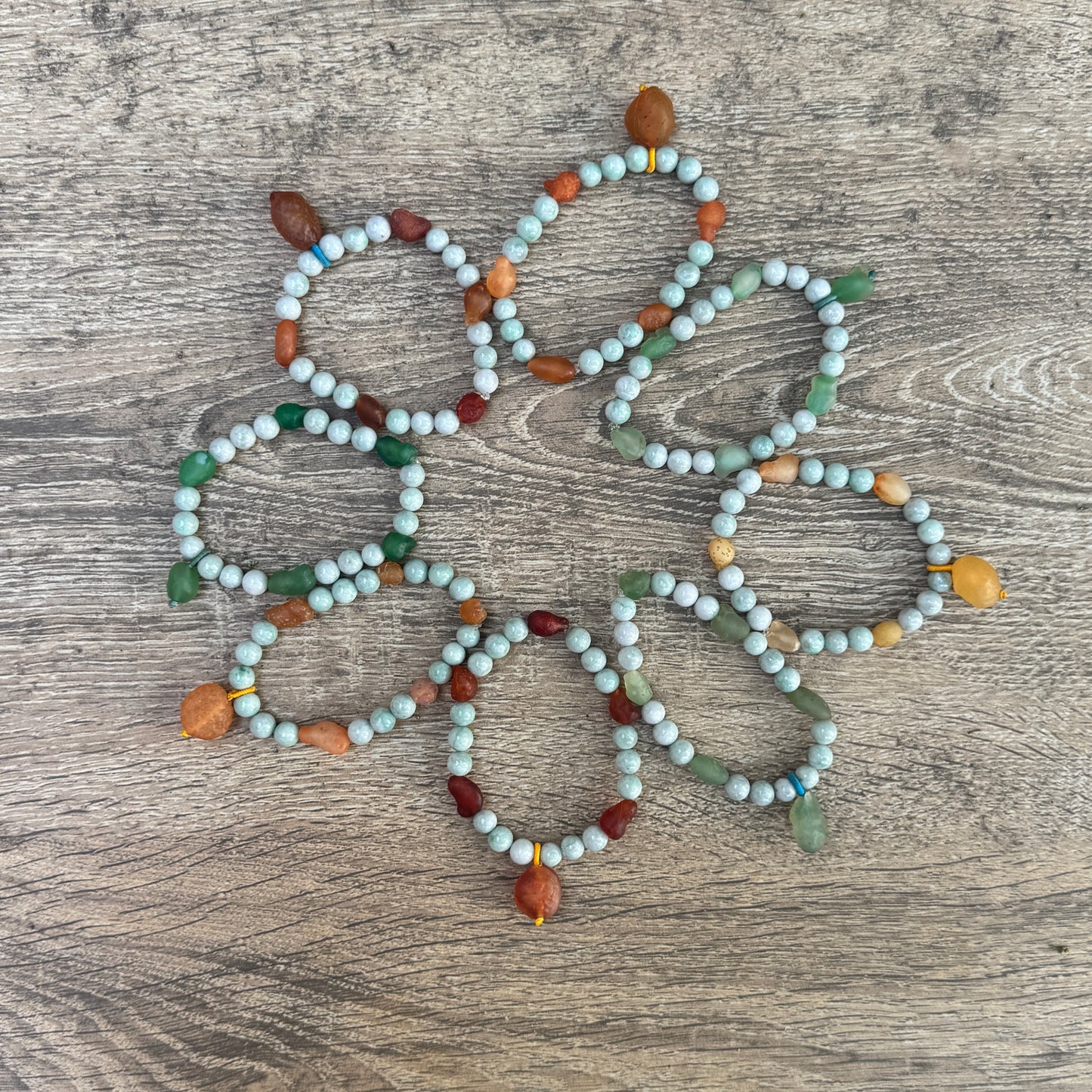
Not all greens are the same. The green of jade is dense and waxy — a color that absorbs light and holds it. The green of a Gobi Desert agate is translucent and layered — a color that lets light pass through it. This bracelet puts both on the wrist at once, and the dialogue between them is the point. Natural green Gobi Desert agates from Mongolia. Natural Type A Kazakh nephrite jade from Kazakhstan. Two ancient materials, one composition.
The Stones
Gobi Desert Agate — Green
Among the rarer finds from the Mongolian desert, green Gobi agates owe their color to trace mineral inclusions — chlorite, celadonite, or other silicate minerals — locked within the stone's silica layers over millions of years. The result is a bead that reads differently in every light: sometimes sage, sometimes moss, sometimes a deep, cool olive. Translucent, naturally patterned, and entirely untreated.
Kazakh Jade (Type A Nephrite)
Kazakhstan's Altai mountains have yielded nephrite jade for centuries. Dense, smooth, and deeply green, these beads carry a grounding weight that balances the agate's lightness. Type A certification means no treatments of any kind — no polymer fills, no bleaching, no color enhancement. The color is the stone's own.
Construction
- Strung on 0.7mm premium stretch cord for a comfortable, slip-on fit
- 8mm beads — a substantial, well-balanced size that wears comfortably on most wrists
- Balanced agate-to-jade ratio — neither stone dominates; both are present
- No clasp required — designed for effortless daily wear
- Handcrafted in small batches; exact bead arrangement varies per piece
Wearing It
This bracelet rewards close attention. The interplay of translucent agate and opaque jade creates a quiet visual rhythm that changes as the bracelet moves. It wears well with linen, silk, and natural fibers — and pairs naturally with gold, oxidized silver, or other stone jewelry. For those who collect jade, this is a piece that extends the conversation into new geological territory.
Care
- Remove before swimming, bathing, or heavy exercise to preserve the stretch cord
- Wipe clean with a soft, dry cloth
- Store flat or loosely coiled — avoid hanging, which can stress the cord over time
- Natural stones may have minor surface variations; these are not flaws — they are proof of origin
Share


Know Your Stone
What is Type A jade?
TypeA jade is natural, untreated stone — no bleaching, no polymer filling, no dye.It's the collector standard and the only grade we carry at JADEscape.Provenance documentation is available on request.
What is the difference between jadeite and nephrite?
Both are true jade, but different minerals.Jadeite is rarer, harder, and found in vivid colors including ImperialGreen.Nephrite is tougher with a silky texture, ranging from creamy white to deep forest green.We carry both.
What is Imperial Green jade?
ImperialGreen is the most prized color grade in jadeite — a vivid, evenly saturated green produced by trace chromium in the stone's crystal structure.TrueImperialGreen is highly translucent,with a depth of color that seems to glow from within.AtJADEscape, when we carry ImperialGreen material, it is always TypeA — natural and untreated.
How do I care for my jade piece?
Clean with a soft damp cloth and mild soap.Avoid ultrasonic cleaners, harsh chemicals, and prolonged sun exposure.Store separately to prevent scratching.With proper care,Type A jade lasts generations.
Do you provide certificates of authenticity?
At JADEscape, we source directly from the mines and the carvers themselves — our provenance comes from the relationship, not a certificate.The jade certification industry is largely unregulated and most commonly used by resellers.We can tell you exactly where a piece came from, who carved it, and what makes it genuine — because we were there.