


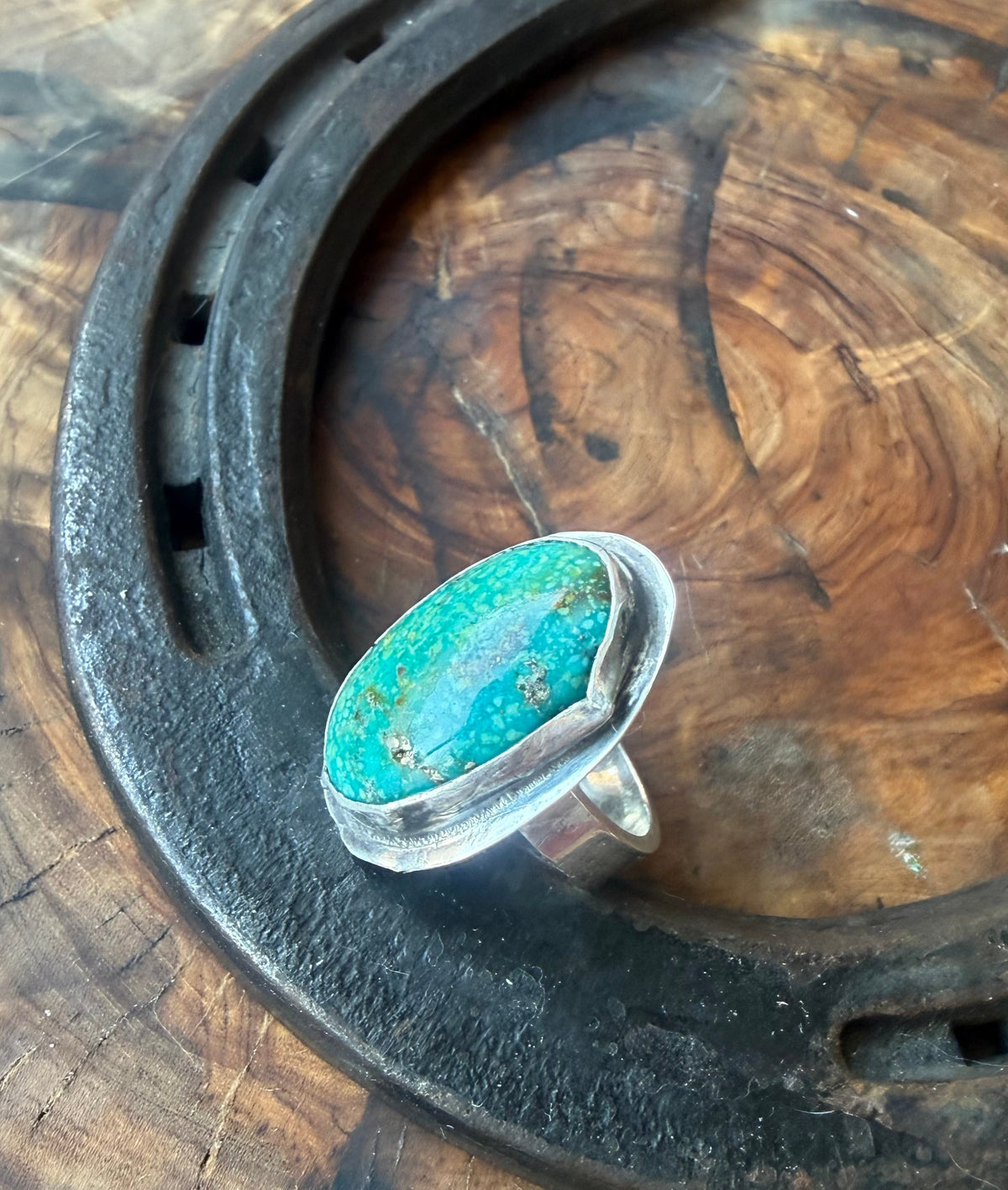
Dorothy Series | Whitewater Turquoise & Pyrite Ring
Dorothy Series | Whitewater Turquoise & Pyrite Ring
Couldn't load pickup availability
A striking Whitewater turquoise cabochon with natural pyrite inclusions, set by hand in sterling silver. The stone carries a vivid blue-green surface with scattered metallic flashes of pyrite and subtle earthy matrix—each marking part of the stone’s natural character.
The substantial oval stone is framed in a clean, hand-fabricated sterling silver setting and finished with a wide, comfortable band. Strong enough to stand entirely on its own, while still carrying the heirloom character of the Dorothy Series.
Details
- Whitewater turquoise with natural pyrite
- Sterling silver
- Hand-fabricated setting
- Size 8
- One of a kind
- Dorothy Series
Legacy in Metal. Heritage in Stone.
Share


Know Your Stone
What is Type A jade?
TypeA jade is natural, untreated stone — no bleaching, no polymer filling, no dye.It's the collector standard and the only grade we carry at JADEscape.Provenance documentation is available on request.
What is the difference between jadeite and nephrite?
Both are true jade, but different minerals.Jadeite is rarer, harder, and found in vivid colors including ImperialGreen.Nephrite is tougher with a silky texture, ranging from creamy white to deep forest green.We carry both.
What is Imperial Green jade?
ImperialGreen is the most prized color grade in jadeite — a vivid, evenly saturated green produced by trace chromium in the stone's crystal structure.TrueImperialGreen is highly translucent,with a depth of color that seems to glow from within.AtJADEscape, when we carry ImperialGreen material, it is always TypeA — natural and untreated.
How do I care for my jade piece?
Clean with a soft damp cloth and mild soap.Avoid ultrasonic cleaners, harsh chemicals, and prolonged sun exposure.Store separately to prevent scratching.With proper care,Type A jade lasts generations.
Do you provide certificates of authenticity?
At JADEscape, we source directly from the mines and the carvers themselves — our provenance comes from the relationship, not a certificate.The jade certification industry is largely unregulated and most commonly used by resellers.We can tell you exactly where a piece came from, who carved it, and what makes it genuine — because we were there.